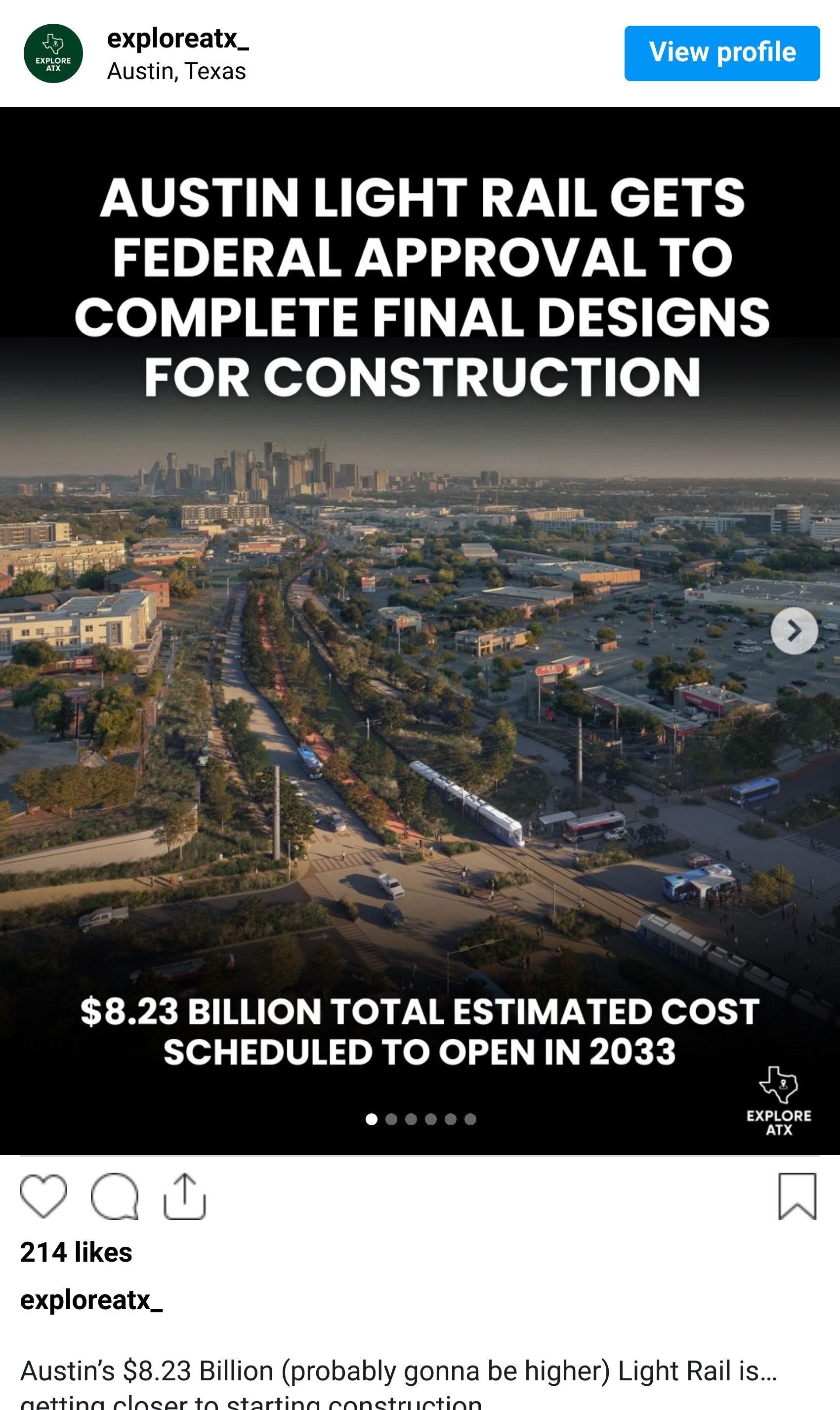

On January 16, 2026, the Federal Transit Administration, operating under the Trump administration, issued a Record of Decision (ROD) for Austin’s long-debated light-rail project. This ruling federally required environmental review process and formally allows the project to advance into final design, land acquisition, utility relocation, and construction preparation—a point many large transit projects never reach.
It is the most consequential federal action taken on Austin light rail to date, and it places the city at a crossroads between long-term transit ambitions and near-term financial and neighborhood impacts.

From Vision to Vote to Federal Approval
Austin’s light-rail concept traces back to Project Connect, a sweeping transit proposal approved by voters in November 2020. At the time, the plan envisioned a far more extensive rail network, including tunnels and longer corridors. Since then, rising construction costs, inflation, and federal funding realities have narrowed the scope to a shorter “starter line” designed to meet federal grant criteria.
Project delivery is now overseen by the Austin Transit Partnership (ATP), which spent several years completing environmental studies, engineering revisions, and community consultations required under federal law. The ROD confirms those requirements are complete.

What the Record of Decision Actually Changes
The federal approval does not guarantee construction funding, nor does it start building rail tomorrow. What it does is unlock the next—and most expensive—phase of work, including:
Final engineering and design
Property and land acquisition, including potential eminent domain
Utility relocation along major corridors
Procurement of multi-billion-dollar construction contracts
Just as importantly, the ROD makes Austin eligible to pursue federal transit grants that could cover up to ~50% of the total $8.23 billion cost, or roughly $4 billion, if the project successfully competes for funding.

The Approved Line: What’s Actually Being Built
The federally approved project is Phase 1, a ~9.8-mile light-rail line with 15 stations. The route runs:
From 38th Street near the University of Texas
Through West Campus and Downtown Austin
Across Lady Bird Lake on a new rail bridge
Down South Congress Avenue
Then southeast toward Riverside and Montopolis
Current projections place opening day in the early 2030s, around 2033, assuming construction and funding stay on schedule.
ATP planning documents project ~18,000–20,000 average weekday riders at opening, with ridership potentially growing over time as the city densifies—figures that remain estimates rather than guarantees.

Future Extensions: Planned, Not Approved
Maps often show additional routes, but it’s important to separate what’s approved from what’s aspirational. Future priority corridors include:
Northward extension from 38th Street to Crestview
East/southeast extension from Yellow Jacket to Austin-Bergstrom International Airport
These extensions are not funded, not federally approved, and not scheduled. They would require new approvals, new grants, and likely new political fights.

What This Means for Austin Now
With federal clearance secured, Austin enters the phase where costs historically rise, disruptions intensify, and timelines stretch. Years of land acquisition, street reconstruction, lane closures, and utility work are expected along some of the city’s busiest corridors—long before riders see any benefit.
Project leaders emphasize job creation and long-term economic impact, but those gains are speculative and decades away. In the near term, Austinites face tax exposure, neighborhood disruption, and the real risk that the final price tag exceeds today’s already-record $8.23 billion estimate.

The Bottom Line
The Trump administration’s approval moves Austin light rail from theory into reality—but also into its most financially risky stage. Whether this project becomes a transformative transit system or a cautionary tale in urban infrastructure will depend on what happens next: funding outcomes, construction management, and whether projected benefits ever materialize at the scale promised.